
About Droven.io: A Detailed Review and Complete Guide
Artificial intelligence is transforming industries faster than ever, and the automotive sector is leading that revolution. If you’ve been searching for reliable information about droven.io, you’re likely wondering what the platform offers, how it works, and whether it’s worth your attention. This guide explores every important aspect in a clear, practical, and unbiased way.
Whether you’re a technology enthusiast, software developer, automotive professional, business owner, or simply curious about AI-driven mobility, understanding about droven.io can help you stay ahead of emerging trends. From AI automation and intelligent driving solutions to industry applications and future possibilities, this guide provides everything you need to know.
What Is About Droven.io?
Droven.io is an AI-focused technology platform associated with intelligent mobility, automotive innovation, and data-driven automation. While publicly available information remains limited compared to larger technology companies, the platform is discussed in relation to modern vehicle intelligence, AI-assisted operations, and digital automotive solutions.
Rather than being a traditional software application, Droven.io represents the growing movement toward integrating artificial intelligence into transportation ecosystems.
Potential areas include:
- Intelligent driving systems
- Vehicle data analytics
- Fleet optimization
- AI-powered automation
- Predictive maintenance
- Smart mobility management
As AI adoption accelerates, platforms like Droven.io demonstrate how software can improve safety, efficiency, and decision-making across the transportation industry.
Understanding How Droven.io Works
Modern AI automotive platforms typically combine several advanced technologies into one ecosystem.
These include:
| Technology | Purpose |
| Machine Learning | Learns from driving data |
| Computer Vision | Detects roads, vehicles, and pedestrians |
| Predictive Analytics | Forecasts maintenance needs |
| Cloud Computing | Processes large amounts of data |
| IoT Sensors | Collects real-time vehicle information |
| Data Analytics | Improves operational decisions |
The general workflow looks like this:
- Sensors gather vehicle data.
- AI algorithms analyze driving conditions.
- The platform predicts potential issues.
- Recommendations are generated.
- Performance continuously improves through learning.
This AI-driven approach helps businesses make smarter transportation decisions while reducing manual processes.
Key Features of Droven.io
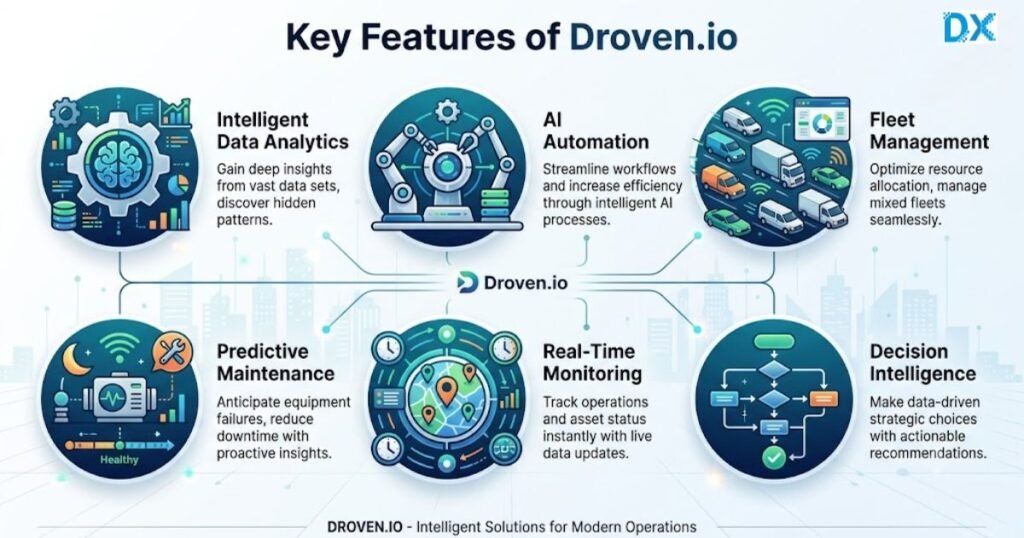
Although specific platform capabilities may evolve over time, AI automotive platforms similar to Droven.io commonly include the following features.
Intelligent Data Analytics
Large amounts of driving and operational data are transformed into useful insights for businesses and fleet managers.
AI Automation
Routine tasks such as monitoring, reporting, and predictive analysis can be automated to improve efficiency.
Fleet Management
Organizations operating multiple vehicles can monitor:
- Fuel efficiency
- Driver behavior
- Route optimization
- Vehicle utilization
- Maintenance schedules
Predictive Maintenance
Instead of waiting for equipment failures, AI predicts maintenance requirements before serious problems occur.
Benefits include:
- Reduced downtime
- Lower repair costs
- Increased vehicle lifespan
Real-Time Monitoring
Connected systems provide continuous updates regarding:
- Vehicle location
- Performance
- Speed
- System health
- Operational status
Decision Intelligence
Machine learning assists businesses by identifying patterns that humans may overlook.
Benefits of Using Droven.io
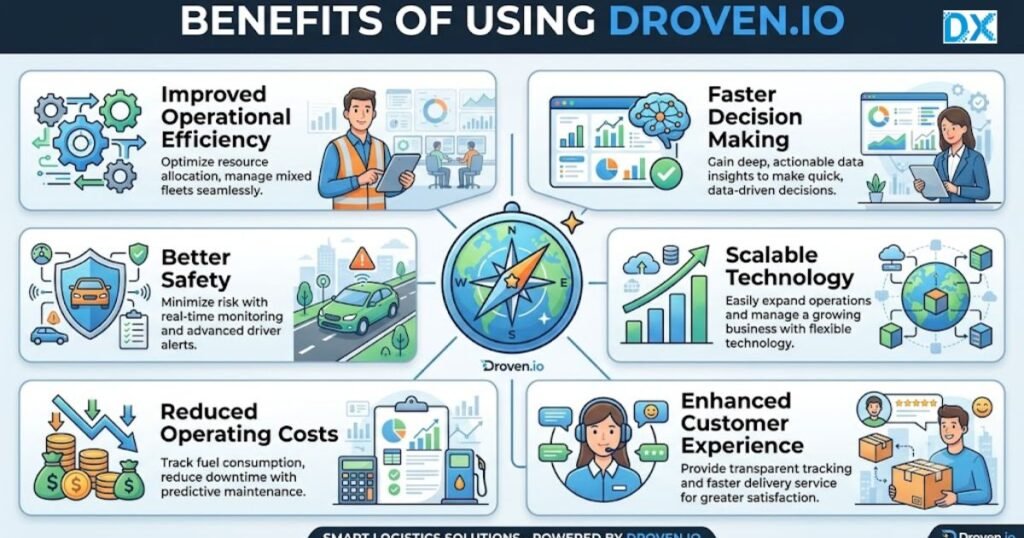
Understanding about droven.io also means recognizing the value AI brings to transportation.
Improved Operational Efficiency
Automation reduces repetitive tasks while increasing productivity.
Better Safety
AI systems continuously analyze road conditions and potential hazards.
Reduced Operating Costs
Organizations can save money through:
- Smarter maintenance
- Fuel optimization
- Efficient routing
- Better resource allocation
Faster Decision Making
Real-time analytics enable managers to respond quickly to changing situations.
Scalable Technology
AI platforms can grow alongside expanding businesses without requiring complete infrastructure replacement.
Enhanced Customer Experience
Businesses can provide:
- More accurate delivery estimates
- Better vehicle reliability
- Improved service quality
Real-World Applications
AI automotive platforms are becoming increasingly common across many industries.
Logistics Companies
Delivery organizations optimize routes while reducing fuel consumption.
Ride-Sharing Services
AI improves driver allocation, navigation, and customer experiences.
Fleet Operators
Fleet managers use predictive analytics to minimize downtime.
Insurance Companies
Vehicle data helps evaluate driving behavior and improve risk assessment.
Smart Cities
Municipalities integrate AI into traffic management systems to reduce congestion.
Manufacturing
Automotive manufacturers analyze production and vehicle performance data to improve quality.
Pros and Cons
| Pros | Cons |
| AI-driven automation | Limited publicly available documentation |
| Improved efficiency | Platform features may evolve over time |
| Predictive maintenance | Learning curve for new users |
| Better operational insights | Enterprise implementation may require investment |
| Supports data-driven decisions | May require integration with existing systems |
Droven.io Compared with Traditional Automotive Solutions
| Feature | Traditional Systems | AI Platforms Like Droven.io |
| Decision Making | Manual | AI Assisted |
| Maintenance | Reactive | Predictive |
| Analytics | Basic Reports | Advanced Insights |
| Automation | Limited | Extensive |
| Learning Capability | None | Continuous Improvement |
| Data Processing | Small Scale | Large Scale |
AI platforms significantly outperform traditional systems by continuously learning from data and improving recommendations over time.
Best Practices for Using AI Automotive Platforms
Organizations considering AI-driven automotive solutions should follow several best practices.
Start with Clear Objectives
Define measurable goals before implementation.
Examples include:
- Lower maintenance costs
- Improve fuel efficiency
- Increase fleet utilization
Ensure Data Quality
AI performs best when trained using accurate, high-quality data.
Protect Data Privacy
Follow cybersecurity standards and industry regulations when handling sensitive information.
Train Employees
Technology delivers better results when users understand how to interpret AI-generated recommendations.
Monitor Performance
Regularly review metrics to ensure the platform continues meeting business objectives.
Future of AI and Droven.io
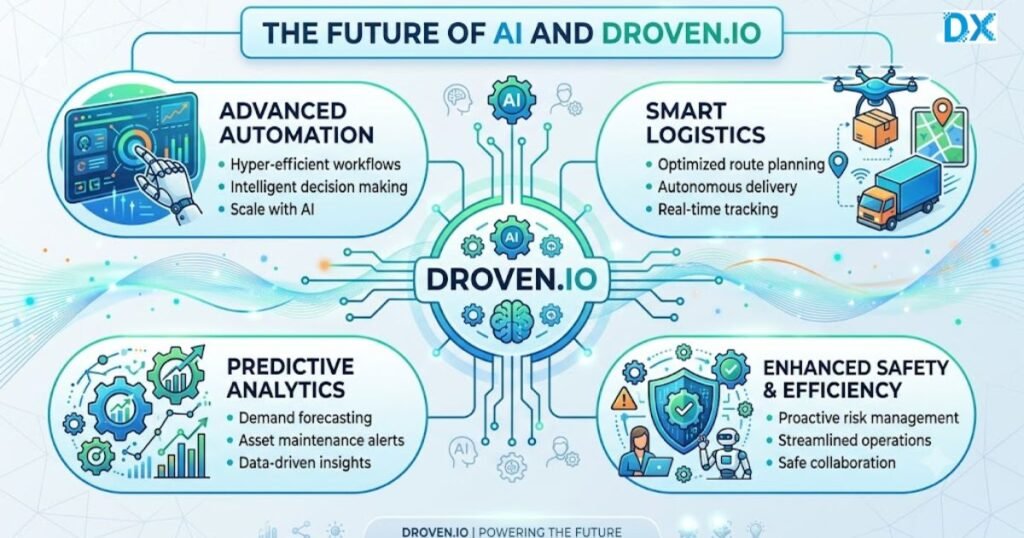
Artificial intelligence continues to reshape transportation.
Industry experts expect future AI automotive platforms to include:
- Fully autonomous vehicle support
- Enhanced predictive analytics
- Better energy optimization
- Smarter traffic coordination
- Advanced digital twins
- Edge AI computing
- Vehicle-to-everything (V2X) communication
As regulations mature and AI technology advances, platforms similar to Droven.io may play increasingly important roles across commercial transportation and mobility services.
Businesses adopting AI early are often better positioned to benefit from operational efficiencies and long-term innovation.
Extra Suggestions About AI
For additional research and authoritative references, readers can explore:
FAQs
Q1. What does Drive AI do?
Answer: Drive AI uses artificial intelligence to analyze driving data, improve vehicle safety, automate decision-making, and optimize transportation systems. Understanding about droven.io helps explain how AI platforms support smarter mobility and operational efficiency.
Q2. Why is AI being used to drive cars?
Answer: AI enables vehicles to recognize roads, detect obstacles, interpret traffic signals, and make real-time driving decisions. Learning about droven.io highlights how AI contributes to safer, more efficient, and intelligent transportation.
Q3. What are the 10 uses of AI?
Answer: AI is widely used in healthcare, finance, education, manufacturing, cybersecurity, customer support, autonomous vehicles, logistics, smart cities, and retail. Exploring about droven.io demonstrates how AI is transforming the automotive industry through automation and analytics.
Q4. What is AI automotive?
Answer: AI automotive refers to the use of artificial intelligence in vehicles and transportation systems for navigation, predictive maintenance, driver assistance, safety monitoring, and automation. About droven.io, this concept reflects the growing adoption of intelligent mobility technologies.
Q5. Which companies are driving AI?
Answer: Leading AI innovators include Google, Microsoft, NVIDIA, OpenAI, Tesla, Amazon, IBM, and Intel. While researching about droven.io, it’s useful to compare emerging platforms with these established AI leaders to understand broader industry trends.
Conclusion
Understanding about droven.io provides valuable insight into how artificial intelligence is reshaping transportation, automotive technology, and intelligent mobility. Although publicly available information about the platform remains relatively limited, the technologies associated with AI-driven vehicle analytics, predictive maintenance, automation, and data intelligence clearly represent the future of modern transportation.
As organizations increasingly embrace AI to improve efficiency, reduce costs, and enhance safety, platforms like Droven.io illustrate the growing importance of intelligent automotive solutions. Whether you’re a technology professional, fleet operator, business decision-maker, or simply exploring the future of AI, staying informed about these innovations will help you better understand the rapidly evolving mobility landscape.